Manufacturing Capabilities for Self-Lubricating Bearings

Explore GLARY's manufacturing resources for self-lubricating bearings and bushings, including custom production coordination, technical communication, inspection requirements and export supply.

Manufacturing Capabilities by Bearing Type

PTFE & POM Composite Bushings

High-volume orders

For large orders of a single size, production is carried out on dedicated, highly automated lines, covering material preparation, forming and final inspection.

The main processes include forming, rolling, sizing and finishing. These lines are suitable for different product designs, including medium and thick-walled bushings, flanged bushings and slotted bushings. They help maintain consistent quality across production batches.

Automated production line with press and operator
Robotic handling on an automated bushing line
Automated production floor for composite bushings
In-process inspection station on the automated line

Small-volume orders

For smaller orders, metal sheets are cut to the required size for each order. The following processes, such as rolling, sizing and welding, are completed using general-purpose machines and manual tools.

  1. Blanking: Sheets are cut to size instead of using automatic feeding systems.
  2. Rolling: Bushings are formed using manual rolling machines or general-purpose presses, with the joint aligned by hand.
  3. Sizing: Manual presses with dedicated mandrels or dies are used to correct the shape and dimensions.
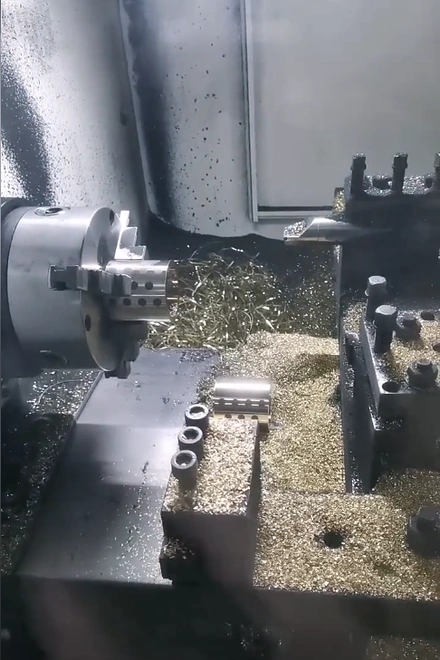
  4. Finishing: Chamfering, oil groove milling and other finishing work are completed using standard lathes or milling machines.
Blanking machine cutting strip for composite bushings
Rolling machine forming a composite bushing
Flange forming on the composite bushing production line
Sizing a bushing on a lathe
Finishing a bushing with coolant on a machine

Inspection and quality control

Automated visual inspection systems and dedicated testing equipment are used to check the outside diameter, wall thickness, roundness and surface defects. All parts are screened, and inspection results are fed back to the production process to help control quality.

For samples, trial orders and special designs, we also use proven manual and semi-automatic production methods. These methods allow smaller order quantities.

The same material requirements and inspection standards apply to both manual and automated production. Key dimensions are checked piece by piece to maintain consistent quality in small batches.

Bimetal Bearings

High-volume orders

For large orders of a single size, bimetal strip is processed on an automated production line. The main steps include:

Automatic feeding → blanking → rolling and forming → sizing → inspection

These lines are suitable for bimetal plates with diameters from Φ30 to Φ80 mm and thicknesses from 2 to 4 mm.

Automated production is more cost-effective for long-term orders of one size or a limited number of sizes, as the cost of dedicated dies and line setup can be spread across larger quantities.

Small-volume orders

For smaller orders, especially large, heavy-duty or non-standard components, individual blanks can be formed or cast and then machined.

General-purpose lathes and milling machines are used for finishing the inside and outside diameters, as well as machining oil holes and grooves. Dimensions are mainly checked using manual measuring tools.

Both automated and manual production follow the same incoming material inspection requirements and finished-product dimensional standards. The production method does not change the agreed quality requirements.

Blanking bimetal strip on a press
Pressing oil grooves into a bimetal bushing blank
Punching the interlock into bimetal strip
Rolling bimetal strip into a bushing
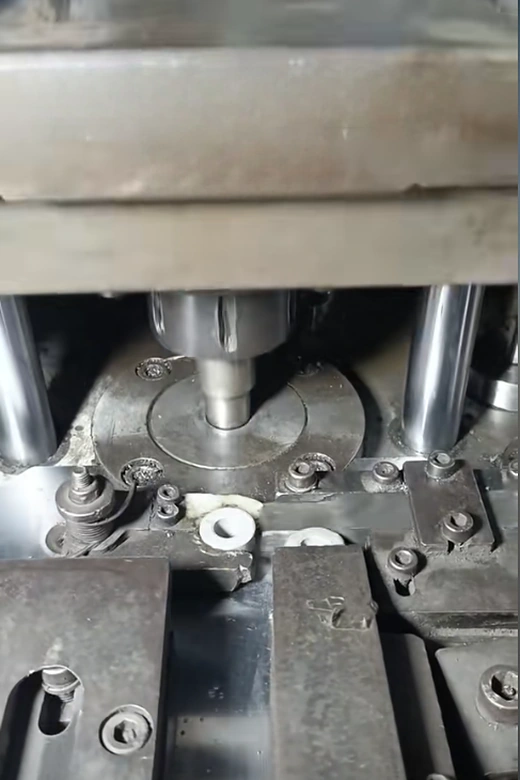
Sizing a flanged bimetal bushing in a press
Chamfering the bore of a bimetal bushing
Vibratory polishing of bimetal bushings
Rust-preventive oiling of finished bimetal bushings

Solid-Lubricated Bearings

1

Copper Alloy Body Production

The bearing body is commonly made from high-strength brass, tin bronze or aluminum bronze.

For large orders, centrifugal casting can be used to produce the bearing blanks. For small orders or non-standard sizes, sleeve blanks can be machined from copper alloy bars or tubes.

2

Machining Graphite Holes

Graphite holes are machined according to the arrangement shown on the product drawing. CNC machines or laser drilling equipment can be used to keep hole positions consistent.

3

Graphite Plug Preparation and Fitting

Graphite plugs are prepared and fitted into the holes. They can be made from pure graphite or graphite-based materials containing additives such as MoS₂ or PTFE to improve lubrication.

4

Final Machining and Inspection

The inside diameter, outside diameter and end faces are finished by turning or grinding to meet the required dimensions and surface finish.

Finished bearings are checked for dimensional accuracy and to make sure the graphite plugs are securely fitted.

Drilling rows of graphite holes on a CNC machine
Fitting graphite plugs into a drilled bronze bushing
Chamfering a graphite plugged bronze bushing
Machining the bore of a graphite plugged bronze bushing
Drilling graphite holes into a bronze bushing

Sintered Bushings

Sintered bushings are made from metal powder. Their porous structure stores lubricating oil after impregnation. During operation, the oil gradually moves through the pores to lubricate the bearing surface.

1

Powder Mixing

Base metal powders, such as copper-based, iron-based or iron-copper powders, are mixed with alloying elements and other required additives. Graphite may be added as a solid lubricant, while forming lubricants such as zinc stearate help the powder flow and form during pressing.

2

Powder Compaction

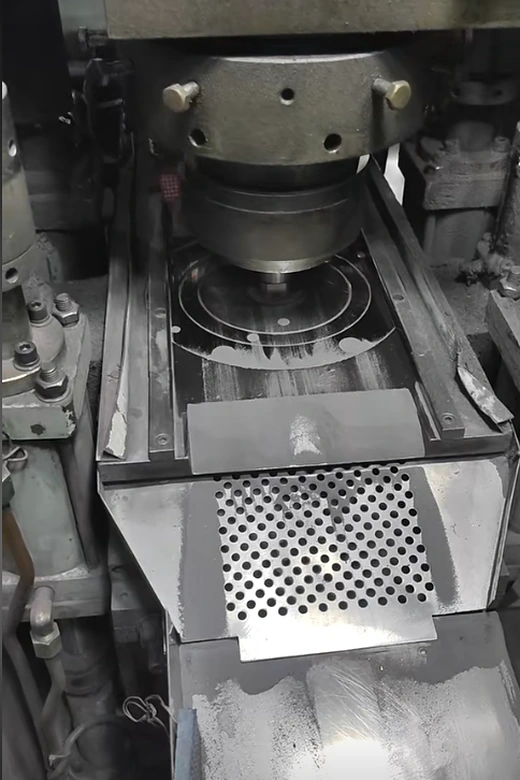
The mixed powder is placed into a die and compressed into a bushing-shaped blank.

The die consists of an outer die, a central mandrel and upper and lower punches. These parts control the inside diameter, outside diameter and height of the bushing.

3

Sintering

The compacted blanks are heated in a protective atmosphere, such as a nitrogen-hydrogen gas mixture, or in a vacuum furnace.

Iron-based materials are commonly sintered at around 1,100–1,120°C, while copper-based materials require lower temperatures.

During sintering, the powder particles bond together while the required interconnected pores remain in the material.

4

Sizing

After sintering, bushings may have slight dimensional changes. Sizing dies are used to correct the inside and outside diameters, improve dimensional accuracy and produce a smoother surface.

This step is especially important for stepped and specially shaped bushings.

5

Oil Impregnation

The sized bushings are immersed in heated lubricating oil so that the oil fills the pores inside the material.

A typical oil impregnation process takes around 60 minutes at approximately 100°C. Vacuum oil impregnation can reduce the process time to around 20–30 minutes.

The oil content is typically 15–25% by volume, providing the oil reserve needed for self-lubricating operation.

Compacting metal powder into a sintered bushing blank
Sintered bushings passing through the sintering furnace
Sizing a sintered bronze bushing in a press
Oil impregnation of sintered bushings

Bronze-Wrapped Bearings

1

Bronze Strip Preparation

High-density copper alloy strip is selected according to the required bushing design. Strip thickness, width and mechanical properties must match the required wall thickness and developed dimensions of the finished bushing.

2

Oil Pocket and Groove Machining

Oil pockets, holes or grooves are machined into the flat bronze strip according to the product design.

3

Blanking

The strip is cut to the required developed dimensions. The blank size is adjusted to account for springback during rolling, helping achieve the required circumference and an even joint gap after forming.

4

Rolling and Forming

The blanks are rolled into open-ended cylindrical bushings using forming dies or rolling machines.

The forming settings and mandrel are adjusted according to the springback of the bronze strip to control roundness and joint gap consistency.

5

Sizing

Sizing mandrels and dies are used to correct the inside and outside diameters, reducing springback and ovality.

6

Inspection

Finished bushings are inspected in batches for dimensional accuracy, oil pocket quality and surface condition.

Custom Bearing Manufacturing

GLARY produces custom bearings and bushings from customer drawings and specific requirements. Each project is checked against its dimensions, design and manufacturing requirements, from drawing review through sample testing.

Drawing-Based Production

When we receive a customer drawing, our technical team reviews it to assess whether the product can be manufactured. Each dimension is checked for manufacturing feasibility and dimensional suitability before production, so potential issues come up early and the design is confirmed before manufacturing begins.

Non-Standard Sizes & Designs

We develop non-standard bushings with thinner or thicker walls, and with custom oil groove and oil pocket layouts. Our R&D team has nearly 100 members and 20 years of experience in bearing design and development, and works on custom requirements for different applications.

Samples & Production Orders

Free samples are available for standard products so customers can test them before placing an order. For non-standard products, free samples can also be provided after the customer approves the tooling arrangement, so dimensions, fit and performance can be checked before mass production.

Dimensional Control & Quality Inspection

We check product quality through material testing, dimensional measurement and production inspection. The methods depend on the product type and manufacturing requirements.

R&D and Testing Equipment

Our testing equipment evaluates material properties, friction and wear performance, and bearing fatigue life.

Bearing Fatigue Testing Machine

Runs bearing materials and products under repeated loading to measure fatigue life.

X-ray CT and Coordinate Measuring System

Combines X-ray imaging with coordinate measurement to inspect internal structure and measure dimensions to high accuracy.

Friction and Wear Testing Machine

Measures friction and wear performance under different test conditions.

Production Inspection Equipment

Automated inspection systems check dimensions and appearance in production, which reduces inspection errors and keeps quality consistent across batches.

Automatic Vision Inspection Systems

On applicable lines, these systems inspect 100% of parts, check dimensions and flag visible defects. Inspected parts then move to automatic packaging.

Automated Visual Inspection Equipment

Production automation upgrades have added dozens of intelligent visual inspection units, which keep inspection stable during mass production.

From Drawing to Shipment

Every order follows the same sequence, from drawing review and production planning to final inspection, packaging and shipment.

1

Drawing Review & Process Planning

The engineering team reviews customer drawings and requirements, checks whether the dimensions and design can be manufactured, and prepares the production instructions, tools and fixtures needed.

2

Production Preparation

The production team prepares the production plan, materials, equipment and workshop arrangements according to the order requirements.

3

Production & Quality Control

The workshops follow the approved drawings and production instructions. The quality control team checks products during production and monitors whether the required quality procedures are followed.

4

Process Coordination

Production management coordinates engineering, quality control and the workshops to keep production on schedule and under control. Some processes, such as electroplating and heat treatment, are arranged through external processing when required. MES systems are also being introduced to support production tracking and process management.

5

Final Inspection, Packaging & Shipment

Finished products are inspected before delivery. After passing inspection, they are packed according to product type and shipping requirements to protect them during transport. Shipment is then arranged according to the agreed delivery terms and schedule.

Discuss Your Bearing Requirements

Looking for standard bearings or a custom bushing design? Our team will review your requirements and help identify a suitable product and manufacturing solution.

  • Product drawings or dimensions
  • Bearing material and design requirements
  • Operating conditions and application details
  • Estimated order quantity

Contact GLARY to discuss your project

Send an Inquiry

Tell us your requirements. We'll get back to you.


Need Self-Lubricating Bearings?

Contact GLARY for bearing solutions and pricing.

Need Self-Lubricating Bearings?

Contact GLARY for bearing solutions and pricing.

后台登录