
Industrial Machinery Bushings
Bushings for conveyors, forklifts, pallet trucks, cranes and lifting equipment. Composite, bimetal, solid lubricated, sintered and bronze wrapped solutions for different loads, movements and operating conditions.
Where might a bushing be used?
Bushings are used at many different points in industrial machinery.
The actual position matters. A pivot joint, roller shaft and lifting linkage can have very different loads, movements and lubrication requirements. Conveyor bushings, forklift mast bushings, pallet jack bushings, crane trolley bushings and hoist bushings are the five machine positions below, and each one carries the load differently.

Conveyor
Bushing position: Roller shaft support. A conveyor bushing can be used at the shaft support point of a roller. The bearing needs to handle repeated rotation and the loads transferred through the roller, and conveyor bushings on a long line repeat that duty at every roller end.
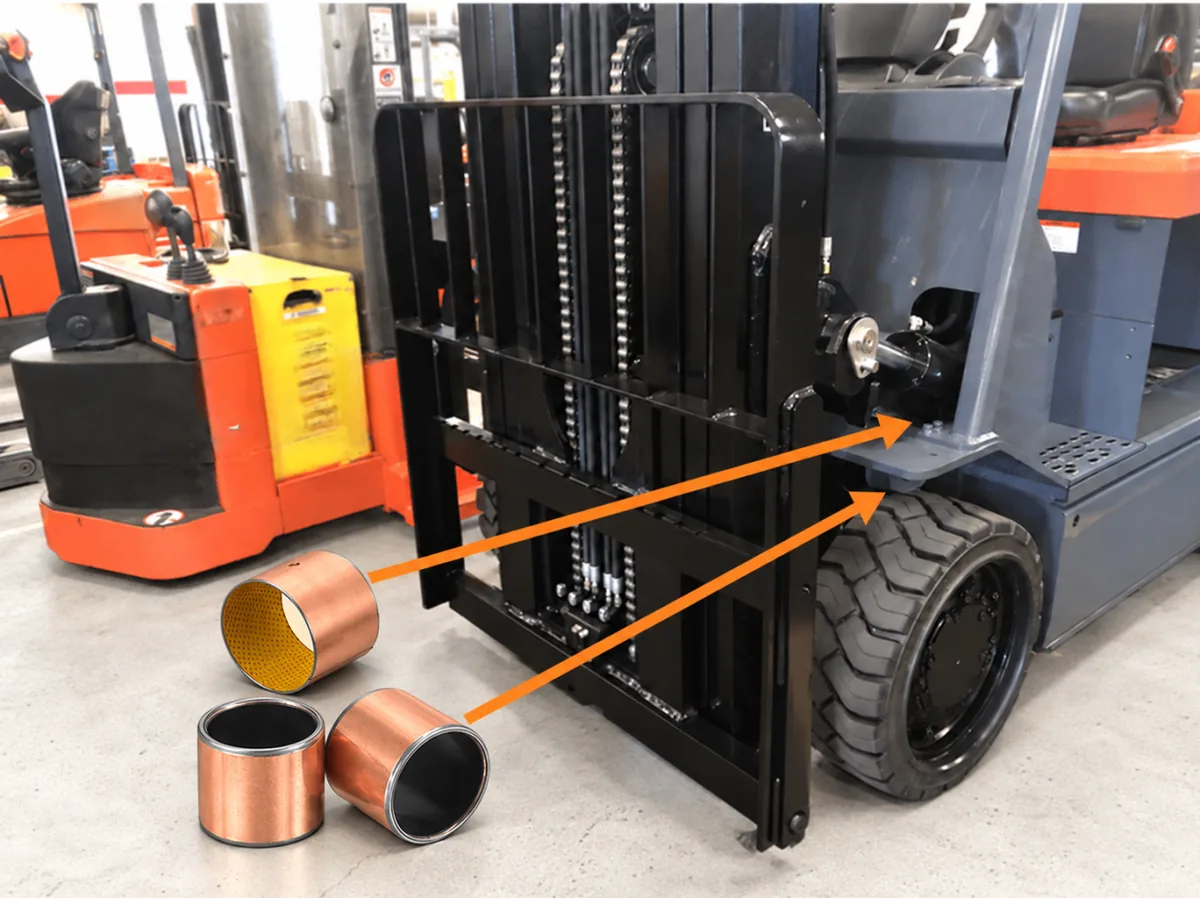
Forklift Mast
Bushing position: Mast pivot. The mast pivots around pins at its mounting points. Forklift mast bushings at these positions support the pin while allowing repeated oscillating movement under load.

Pallet Truck
Bushing position: Lift arm pivot. The lift mechanism uses pivoting arms and links to raise the forks. Pallet jack bushings and pallet truck bushings at these joints work with the pivot pins and see repeated oscillating movement.
Crane Trolley
Bushing position: Wheel / axle bearing point. Crane trolley components can operate under high loads and repeated movement. Where a plain-bearing arrangement is used, a crane trolley bushing needs to handle load, impact and intermittent operation. Crane trolley bushings carry that load as a sliding motion, which is why they wear differently from a rolling trolley wheel bearing.

Hoist
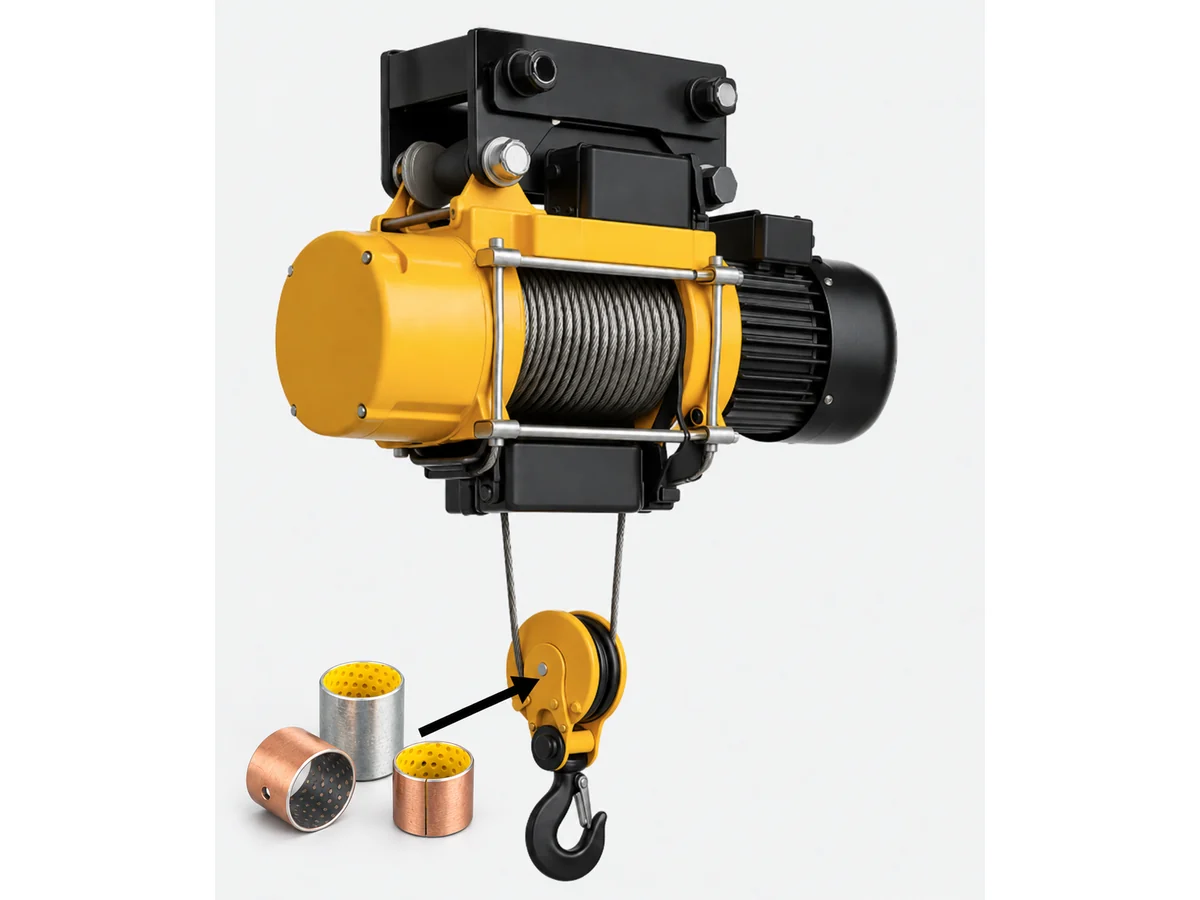
Bushing position: Rope pulley / sheave shaft. A hoist pulley rotates around a fixed shaft or pin while carrying the rope load. Hoist bushings can provide a simple bearing arrangement for this type of rotating or intermittent movement. The actual position varies between hoist designs, so lifting equipment bushings should be confirmed from the original construction before they are ordered.
What Is the Bushing Actually Doing?
A bushing controls the movement between a shaft or pin and the surrounding component.
Depending on the machine, the movement may be continuous rotation, slow rotation, oscillating movement, pivoting movement or reciprocating movement. At the same time, the bushing has to carry the load transferred through the joint. That is why the same machine can use different bearing arrangements at different positions.
Continuous rotation
Slow rotation
Oscillating movement
Pivoting movement
Reciprocating movement
A conveyor roller does not have the same requirements as a pallet truck lift-arm pivot, and a hoist pulley works under different conditions from a crane trolley. Pallet truck bushings, hoist bushings and crane trolley bushings each sit in one of those positions.
The bushing should be selected for the actual bearing position, its load, movement and speed, and not simply by the machine name. That applies to conveyor bushings, forklift mast bushings, pallet jack bushings, crane trolley bushings and hoist bushings alike.
When Does a Bushing Need Attention?
A worn bushing does not always fail suddenly. Look for changes such as the five below, and check the shaft and housing alongside the bushing before concluding that the bushing is the cause.
Why inspect the shaft as well?
Replacing the bushing alone does not always solve the problem.
Check the mating shaft or pin for:
A new bushing cannot compensate for a badly worn mating surface.
For replacement projects, it is better to check the bushing and the shaft or pin together.
Five GLARY Bushing Families
Different machine positions require different bearing constructions. GLARY supplies five main bushing families for different combinations of load, speed, movement, lubrication and operating environment.

Composite Bushings
Metal-backed composite bushings with a low-friction sliding layer. They suit rotating, oscillating and reciprocating movements where compact construction and reduced maintenance matter.

Bimetal Bearings
Steel-backed bushings with a sintered bronze bearing layer, built for applications that need higher load capacity and strong mechanical support. Lubrication is selected according to the working conditions.

Solid Lubricated Bearings
Metallic bushings with solid lubricant incorporated into the bearing surface. They handle heavy loads and intermittent movement, and suit positions where regular lubrication is difficult.

Sintered Bushings
Oil-impregnated powder-metal bushings that retain the lubricant within the bearing material. They are common in rotating applications where the load and speed stay inside the material's operating range.

Bronze Wrapped Bushings
Wrapped bronze bushings with lubrication holes or pockets for grease or oil. They suit demanding applications involving high loads, impact, contamination or slow oscillating movement.
How do you choose the right bushing?
Start with the actual bearing position, then look at the conditions around it.
Movement → Load → Speed → Lubrication → Environment → Shaft Condition
-
Movement
First, identify how the bushing moves. Is it continuously rotating, slowly rotating, oscillating, pivoting or reciprocating? A pivot joint and a continuously rotating shaft should not be treated the same way.
-
Load
Check the normal working load as well as shock or peak loads. Heavy equipment can put much higher loads on a bushing during starting, stopping or impact.
-
Speed
Consider how fast the shaft or pin moves. Load and speed work together, so a bushing suitable for a slow, heavily loaded pivot may not be suitable for a faster rotating shaft.
-
Lubrication
Check whether grease or oil can be supplied regularly. If the bearing position is difficult to access, a self-lubricating or solid-lubricated construction may be more suitable.
-
Working Environment
Look at the conditions around the bearing. Dust, water, dirt, corrosion, temperature and chemicals can all affect bushing selection and service life.
-
Shaft or Pin Condition
Finally, check the mating shaft or pin. Diameter, hardness, surface condition, wear and alignment can all affect how the new bushing performs.
The right bushing is selected for the actual position and working conditions, and not simply by the machine name. Conveyor bushings, forklift mast bushings, pallet jack bushings, crane trolley bushings and hoist bushings all follow the same rule.
Before ordering a replacement
For a replacement bushing, the machine model alone is often not enough.
If available, send us:
- Bushing inside diameter
- Outside diameter
- Length
- Flange dimensions
- Shaft or pin diameter
- Load
- Movement and speed
- Lubrication condition
- Operating temperature
- Working environment
A drawing, old bushing or sample makes the selection easier. Send us the application details and we can check the suitable bushing construction.
FAQ
Does every conveyor roller use a bushing?
No. Conveyor bearing arrangements vary by design. A roller may use a plain bushing, a rolling bearing or another bearing arrangement, so the actual construction should be identified before specifying a replacement. The same applies at a crane trolley bushing position or a hoist bushing bore, where hoist bushings and trolley bushings alike are decided by the drawing or the existing part rather than by the machine model.
Can a forklift mast guide roller be replaced with a bushing?
Not as a general rule. Mast guide and support arrangements can use rolling bearings, so the original component needs to be identified first. The original part, or the equipment drawing, is what confirms which type of bearing the position was built for.
Is a bushing selected mainly by its inside diameter?
No. Shaft diameter is only one part of the selection. Load, movement, speed, lubrication, temperature, environment, housing dimensions and required clearance also matter.
Can I use the same material for a rotating and oscillating application?
Not automatically. A material suitable for one movement and operating condition may not be suitable for another. The manufacturer's technical data should be checked against the actual application.
Should I measure the old bushing or the shaft?
Ideally, both. If the old bushing has worn, its dimensions may no longer represent the original design clearance. The shaft or pin and housing should also be inspected. This matters most at a heavily loaded position such as a pallet truck bushing axle, where the old bushing has usually worn the most.
Have an application to review?
If you are looking for a conveyor bushing, forklift mast bushing, pallet truck bushing, crane trolley bushing or hoist bushing, send us the existing part, drawing or application details. The more we know about the load, movement, speed and lubrication, the more accurately we can match the bushing construction to the application. The drawing, the material and the main dimensions are confirmed before production, and the packing list states material, quantity and part number for each size. If you need a dimensional inspection record with the shipment, ask for it on the inquiry. If some information is unavailable, the drawing, sample or existing part is enough to start from.
Need Self-Lubricating Bearings?
Contact GLARY for bearing solutions and pricing.