Combine Harvester Bushings for Header, Reel and Sieve Pivots
Combine Harvester Bushings sit in the header linkage, the reel arms and the cleaning shoe. Dust and chaff reach those joints all day, and the harvester bushings there often run dry: the grease points inside the header and the shoe are easy to miss.
Where Are Bushings Used on a Combine Harvester?
Combine harvester bushings are used at header linkages, pivot points and hydraulic cylinder mounts, and they are built for oscillating loads, vibration, dust and field conditions. GLARY supplies them as self-lubricating and lubricated solutions.
Bushings are mainly used at pivoting and linkage joints, where a pin connects two moving components. On a combine harvester, the main bushing positions are the header, the hydraulic cylinder mounts and other articulated mechanisms. Combine harvesters use bushings mainly at joints where one component moves relative to another around a pin or a shaft.
The bushing is normally installed between the pin and the housing, linkage or mounting bracket. Its job is to provide a controlled bearing surface while allowing the joint to move.


Header Linkages
Header linkages contain multiple pivoting connections that move as the header follows the working position. The bushings at these points may be exposed to:
- Repeated oscillating movement
- Shock loading
- Dust and crop residue
- Frequent changes in load direction
The bushing needs to maintain suitable clearance between the pin and the linkage throughout the operating cycle.
Header and Reel Pivot Points
Pivot points allow the header or the reel mechanism to move relative to the main structure. These are generally low-speed, oscillating applications rather than continuous rotation.
The bushing should therefore be selected according to the actual load, oscillation angle, lubrication condition and contamination level.
Hydraulic Cylinder Mounts
Hydraulic cylinder mounting points are another common bushing application. The cylinder body or the rod end pivots around a pin as the hydraulic cylinder extends and retracts. The joint can experience:
- High radial load
- Repeated oscillation
- Shock loading
- Misalignment
- Dust and field contamination
For these positions, the bushing and the pin should be considered as one working system.
Auger and Discharge Mechanisms
Auger and discharge mechanisms may contain pivoting and linkage joints that operate under repeated movement and vibration.
The actual bushing requirement depends on whether the joint is continuously rotating, slowly oscillating or moving through a limited angle.
Hinges and Other Pivot Points
Smaller bushings may also be used in doors, covers, chutes and other hinged components, where the loads are normally lower.
The bushing still has to match the pin size, the housing fit, the movement and the lubrication condition at the position.
What Does the Bushing Actually Do?
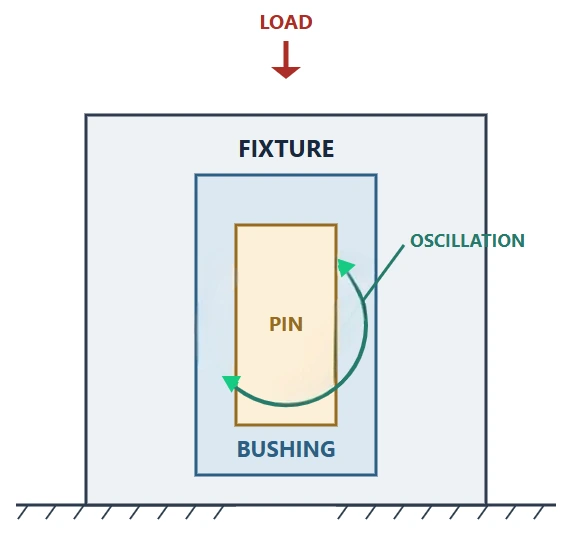
In a typical combine harvester joint the load path runs pin, bushing, housing or linkage.
The bushing provides the controlled sliding interface between the moving pin and the surrounding component.
A correctly selected bushing helps control:
- Radial clearance
- Friction
- Wear
- Load distribution
- Joint movement
The bushing is normally the replaceable wear component. If it wears excessively, the pin and the housing can be damaged as well, and neither is as easy to renew as the bushing.
What Happens When the Bushing Is Not Doing Its Job?

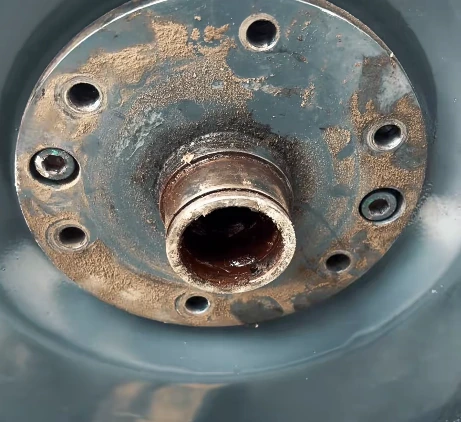
A worn bushing does more than create clearance.
As the bushing wears, the gap between the pin and the bushing increases. The resulting movement transfers more impact and load to the pin and the surrounding components.
Normal Joint
Pin, bushing, housing. Controlled clearance and movement.
Worn Bushing
The pin no longer slides on the bore. It crosses the extra clearance, and every reversal lands as an impact.
Secondary Wear
Next comes the pin, and after that the housing or linkage. Leave the worn bushing in place and the pin or the housing may need repair too.
How Do You Know the Bushing Needs to Be Replaced?
A worn bushing does not always fail suddenly.
Look for changes in the joint rather than waiting for complete failure.
Excessive Radial Play
The pin or the connected component moves more than expected. Excessive play is one of the clearest signs that the bearing clearance has increased.
Visible Bushing Wear
Look for scoring, cracks, deformation, uneven wear or material loss. The wear pattern can also provide information about the operating condition.
Pin Wear
Check the pin at the same time. A worn bushing can allow the pin to develop grooves, flat spots or an uneven surface.
Abnormal Noise
Knocking or impact noise during movement may indicate excessive clearance.
Increased Vibration
If vibration at a linkage or a pivot has increased compared with normal operation, inspect the joint for wear and clearance.
Difficult or Uneven Movement
A joint that becomes tight, uneven or unstable may have a bushing, pin, alignment or lubrication problem.
What Happens If You Keep Running With a Worn Bushing?


A worn bushing can gradually turn into a larger repair.
- Bushing wear
- Clearance increases
- Pin movement increases
- Pin starts to wear
- Housing or linkage bore may wear
- Joint alignment can change
- Repair becomes more extensive
For a combine harvester, this can be particularly inconvenient during harvest, when equipment availability matters.
If the pin and the housing are still within the required dimensions, replacing the bushing may be enough. If the pin or the housing is already worn, the complete joint should be assessed before a replacement bushing is installed.
The Main Engineering Challenge: Load, Movement and Contamination
Combine harvester joints do not operate under one fixed condition.
Loads change as the machine moves through the field. Linkages reverse direction repeatedly, hydraulic cylinders oscillate around their mounting pins, and dust and crop residue can reach exposed joints.
The main questions are:
How Much Load Does the Joint Carry?
Higher loads require a material and a bearing area capable of supporting the applied load without excessive wear.
How Does the Joint Move?
Continuous rotation is different from slow, limited-angle oscillation. Many combine harvester joints are primarily oscillating applications.
Does the Joint Run Dry or Lubricated?
If regular lubrication is difficult, a self-lubricating solution is an option. If greasing is part of normal maintenance, a lubricated bearing material may be suitable.
How Much Contamination Reaches the Joint?
Dust, crop residue and moisture can affect the service life of the bearing interface.
Is Shock Loading Present?
Header and heavy linkage positions may experience changing loads and impact forces, and the bushing material and the bearing area should be selected accordingly.
Which Bushing Material Fits Your Application?
The right bushing depends on the joint, not simply on the machine.
Two bushings on the same combine harvester may require different materials, because their loads, movement, lubrication and contamination levels are different.
| Bushing Type | Typical Condition | Possible Combine Harvester Positions |
|---|---|---|
| PTFE Composite | Dry running, low friction, oscillating movement, moderate load | Linkage and selected pivot points |
| POM Composite | Lubricated, wear-resistant, oscillating movement | Linkage and pivot joints |
| Solid Lubricated | High load, slow movement, difficult lubrication, shock | Heavy-duty linkage and pivot points |
| Bimetal | Higher load, lubricated operation, compact installation | Hydraulic cylinder mounts and heavy pivot joints |
| Bronze Wrapped | Grease-lubricated, robust pivot applications | Larger or heavily loaded pivot joints |

PTFE Composite Bushings
PTFE composite bushings go where low friction and dry running matter. They suit oscillating movement, limited lubrication and moderate loads inside the material rating.
View product
POM Composite Bushings
POM composite bushings suit positions that need good wear resistance and a robust sliding layer: oscillating movement, lubrication and moderate to higher loads inside the material range.
View product
Solid Lubricated Bearings
Solid lubricated bearings are for demanding low-speed positions where the load is high and lubrication is difficult: heavy-duty linkage and pivot points that oscillate slowly, take shock loading, or sit where grease cannot be reached.
View product
Bimetal Bearings
Bimetal bearings carry higher loads on a strong steel backing. They suit higher-load, lubricated and oscillating positions, including some hydraulic cylinder mounting points and heavy pivot joints.
View product
Bronze Wrapped Bushings
Bronze wrapped bushings are for robust, grease-lubricated positions: larger or heavily loaded pivot arrangements, where regular lubrication is available.
View productDon't Select the Bushing by Load Alone
A high load does not automatically mean that a high-load bushing is the correct solution.
A lightly loaded joint that oscillates through a large angle can have a different wear condition from a heavily loaded joint that moves only occasionally.
Material selection should therefore consider the complete working condition:
Load + Movement + Lubrication + Environment + Clearance
The bushing material should work together with the pin, the housing and the joint design.
What Information Do We Need?
For an existing combine harvester, the current bushing and installation are usually the best starting point.
| Parameter | What We Need to Know |
|---|---|
| Bushing ID | Pin diameter |
| Bushing OD | Housing bore |
| Length | Bearing width |
| Load | Radial and peak load |
| Movement | Oscillating, rotating or reciprocating |
| Oscillation Angle | Approximate movement angle |
| Speed | Movement speed where applicable |
| Lubrication | Dry, grease or other lubrication |
| Environment | Dust, crop residue, moisture |
| Temperature | Normal and peak temperature |
| Quantity | Required quantity |
| Drawing / Sample | Preferred if available |
For a new design, load, movement and lubrication should be determined before the bushing material is selected.
Check the Pin and Housing Before Ordering
Replacing the bushing without checking the mating components can lead to another early failure.
| Check the Pin | Check the Housing | Check the Bushing |
|---|---|---|
| Look for: wear, grooves, flat spots, corrosion, excessive surface roughness. | Look for: oversized bore, out-of-round condition, damage from a loose bushing, misalignment. | Confirm: ID, OD, length, wall thickness, flange dimensions if applicable, material, lubrication requirements. |
| If the pin or the housing has already worn beyond the required tolerance, installing a new bushing alone may not restore the joint correctly. | ||
Not Sure Which Bushing Material You Need?
You do not need to select the material before contacting GLARY.
Send us any information you have:
ID × OD × Length
Diameter and condition
Bore diameter and available length
Load, movement, speed and temperature
Dust, crop residue and moisture
Dry running, grease or other lubrication
A drawing, a photo of the installation or an existing bushing sample can also help. We can review the application and discuss a suitable bushing material and design.
FAQ
Can you manufacture a replacement bushing from a sample?
Yes. An existing bushing can be used as a starting point for checking dimensions, material requirements and replacement design.
Can you make bushings according to our drawing?
Yes. Send your drawing with the required dimensions, tolerances and material requirements for review.
What if the original bushing material is unknown?
That is not necessarily a problem. If you provide the application, dimensions, load, movement and lubrication conditions, we can discuss possible material options.
Do you check the pin and housing dimensions?
We can review the mating dimensions you provide and discuss the required bushing dimensions and fit. For a worn joint, the actual pin and housing condition should also be checked before replacement.
Can one bushing material be used throughout the combine harvester?
Not necessarily. Different joints can have different loads, movement, lubrication and contamination levels. Material selection should therefore be based on each application's working conditions.
Can you supply small replacement quantities?
Replacement quantities can be discussed according to the required size, design and production requirements.
Can you produce non-standard dimensions?
Yes. Custom dimensions and designs can be discussed based on drawings, samples or application requirements.
What is the fastest way to get a quotation?
Send the drawing or bushing dimensions together with the required quantity. If available, also include the application, load, movement and lubrication condition.
Need a Replacement Combine Harvester Bushing?
Send us your drawing, dimensions or existing bushing sample. We can help review the working conditions and discuss the suitable bushing material and design.
Need Self-Lubricating Bearings?
Contact GLARY for bearing solutions and pricing.