
Valve Components Bushings
Bushings for valve shafts and moving components that need reliable sliding or rotary support.
Where Are Bushings Used in Valve Components?
Valve bushings are used at support points where a moving valve component runs against a housing or another fixed part. Most valve shaft bushings sit in the body, the bonnet, the yoke, or a bracket, and the exact valve bushing location depends on the valve design.

Valve Shaft Support
A bushing can support a valve shaft where it passes through the valve body, bonnet, bracket, or another supporting structure. It keeps the shaft in position and gives it a controlled sliding surface, which is the guide and support job the packing or the bellows is not there to do.
Rotary Support
Some valve components rotate through a limited angle or through repeated cycles. A bushing at the shaft support controls radial movement and helps reduce friction between the shaft and the housing.
Sliding Support
Other components move back and forth along a guided path. The bushing provides the wear surface between the moving part and the structure around it, and it is the part chosen to reduce wear on the shaft and the housing bore.
Guide and Support Points
A valve may have more than one bushing location, and which one matters depends on where the guide and support point sits, how the moving component moves, and what load reaches the bushing.
Valve Shaft Support and Alignment
A valve shaft needs stable support to move in the correct position. When the shaft is not properly supported, the bushing carries uneven loads, friction rises, and wear accelerates. Valve shaft alignment is what keeps the contact even around the bore.
Shaft Support
The bushing provides a bearing surface between the shaft and its supporting structure. This matters most for valve shaft bushings that rotate, oscillate, or move through repeated cycles.
Shaft Alignment
The shaft and the bushing should stay properly aligned during operation, and valve shaft alignment has to hold through the full stroke or rotation. Poor alignment creates uneven contact around the bushing, and in some designs that leads to localized wear and higher operating resistance.
Why It Matters
A suitable bushing should:
- support the shaft at the required location
- maintain the required running clearance
- handle the expected load
- accommodate the actual movement
- reduce friction and wear
The bushing has to be selected together with the shaft, the housing, the load, the movement, and the operating environment. Valve shaft bushings are quoted with the shaft and the housing, because the bore tolerance and the wall thickness follow from the load, the temperature, and the environment. Valve bushing material and clearance come out of the same review, and valve component alignment is the first thing to suffer when the bore and the shaft are not measured before the material is chosen. Butterfly valve bushings and gate valve bushings load the bore differently, so the review is run position by position.
Bushings for Different Valve Components
Different valve designs place different demands on their support points. The bushing should be selected from the actual component and the operating condition rather than from the valve name alone, because the valve bushing dimensions come from the shaft and the housing, not from the valve family.
Control Valve Bushings
Control valves contain moving components that operate repeatedly during adjustment.
Bushings may be used at shaft or guide support points where repeated movement needs a controlled sliding interface, and the same position is cycled every time the loop moves.
For control valve bushings the main selection factors are movement, load, temperature, clearance, and lubrication.
Butterfly Valve Bushings
Butterfly valves use a rotating shaft to operate the disc.
Bushings can be used at shaft support locations to control radial movement and provide a low-friction bearing surface.
For butterfly valve bushings, check valve shaft alignment, load, rotation, and the operating environment before selecting the bushing.
Gate Valve Bushings
Gate valve designs can contain guided or supported moving components.
Bushings may be used where a shaft or another moving component requires mechanical support, which on gate valve bushings is usually the yoke and the bonnet guide.
For gate valve bushings the required part depends on the actual support location, the load, the movement, and the lubrication condition.
Ball Valve Bushings
Ball valves use a rotating shaft or stem to transmit movement to the ball.
Where a bushing is used at a shaft support location, it has to accommodate the actual rotation, radial load, clearance, and operating environment.
For ball valve applications, ball valve stem bushings overlap with the specific stem application covered on our Valve Stem Bushings page.
Sliding Support or Rotary Support?
The movement of the component is one of the first things to check when selecting a valve bushing.
Sliding Support
Sliding support is used where the component moves along its axis or through a guided path.
Typical considerations include:
- load
- sliding speed
- stroke or movement frequency
- clearance
- temperature
- lubrication
The bushing should give a stable sliding surface without creating excessive friction, which is what control valve bushings on a guided plug and gate valve bushings both need.
Rotary Support
Rotary support is used where a shaft rotates inside a fixed support.
Typical considerations include:
- radial load
- rotational speed
- oscillation angle
- operating cycles
- shaft alignment
- lubrication
For rotary valve components, correct valve shaft support is important because uneven contact increases wear and operating resistance. That covers butterfly valve bushings, ball valve stem bushings, and any other quarter-turn position on the valve.
When Should a Valve Component Bushing Be Replaced?
A valve bushing does not always fail suddenly. In many cases the first signs appear as changes in shaft movement, clearance, or operating resistance.
Look for these signs:
Excessive Shaft Movement
If the shaft has more radial movement than normal, the bushing or the surrounding support may have worn.
Increased Operating Resistance
Higher friction increases the force or torque needed to move the valve component, and on control valve bushings it shows up as actuator torque or motor current creeping up.
Uneven Bushing Wear
Wear concentrated on one side of the bushing points to misalignment, excessive load, or an incorrect running condition.
Increased Clearance
A worn bushing creates more clearance between the shaft and the support, which affects valve component alignment and allows unwanted movement.
Shaft Surface Damage
Do not inspect only the bushing. If the shaft surface is already worn, scratched, or damaged, a new bushing on its own will not reduce wear for long.
Repeated Bushing Failure
If the replacement bushing wears out again after a short service period, check the operating conditions before ordering another identical valve shaft bushing.
Why Does a Valve Bushing Wear Too Early?
A short bushing service life does not always mean the material is poor, so check the complete bearing condition.
Misalignment
If the shaft and the bushing are not properly aligned, the load concentrates on one side, and no grade will reduce wear evenly across the bore.
Excessive Load
A bushing selected for a lower load wears rapidly when the actual operating load is higher.
Insufficient Clearance
Too little clearance increases friction, especially when temperature changes affect the shaft and bushing dimensions.
Excessive Clearance
Too much clearance allows shaft movement and creates uneven loading.
Incorrect Lubrication
A lubricated bushing can fail early when lubrication is insufficient, unsuitable, or difficult to maintain, which is a common cause on ball valve stem bushings and other lubricated rotary positions.
Contamination
Dust, water, process media, or other contaminants affect the sliding surface depending on the bushing design.
Wrong Material for the Movement
A material that works well for slow oscillation may be the wrong choice for a different combination of speed, load, temperature, and lubrication, so material selection has to follow the working condition rather than the material used last time.
If a replacement bushing has failed repeatedly, check the shaft, the housing, the clearance, the load, the movement, and the lubrication condition before changing only the bushing material.
How to Identify the Bushing Location from a Valve Drawing?
When ordering a valve component bushing, the valve model alone is usually not enough. Start with the assembly drawing and identify:
- 1The moving component
Is it a shaft, a stem, a guide, or another moving part?
- 2The support point
Where does the moving component pass through or contact a fixed housing?
- 3The bushing position
Check whether the bushing is installed in the valve body, bonnet, bracket, guide, or another support structure; on control valve bushings it is often the bonnet or the yoke.
- 4The shaft and housing dimensions
Measure the shaft diameter and the finished housing bore where possible.
- 5The movement
Confirm whether the component rotates, oscillates, slides, or combines different movements.
If the valve bushing location is unclear, send us the valve assembly drawing or a photo of the existing component.
We can help identify the information needed for the bushing: the shaft diameter, the housing bore, the movement, and the working conditions that set the valve bushing dimensions.
Replacing a Worn Bushing? Check These 5 Things First
Before ordering a replacement, do not measure only the old bushing.
Check the Shaft
Measure the shaft diameter and inspect the surface for wear or scoring. That reading and the housing bore are what fix the valve bushing dimensions.
Check the Housing
The housing bore can also wear. If it is no longer within the required dimension, a new bushing may not fit or run correctly, and valve component alignment is lost before the new part is even pressed in.
Check the Old Bushing
The wear pattern gives useful information about the operating condition. Look for:
- one-sided wear
- scoring
- deformation
- excessive clearance
- surface damage
Check the Operating Conditions
Record:
- load
- temperature
- movement
- speed or cycle frequency
- lubrication
- surrounding environment
Check Whether the Same Material Is Still Suitable
If the old bushing failed early, copying the old valve bushing material may not be the best solution. The replacement should be reviewed against the actual working conditions.
Which GLARY Bushing Fits a Valve Component?
There is no single valve bushing material for every valve component. The right choice depends on the load, the movement, the temperature, the lubrication, and the installation conditions. Material selection follows the load, the temperature, and the movement.
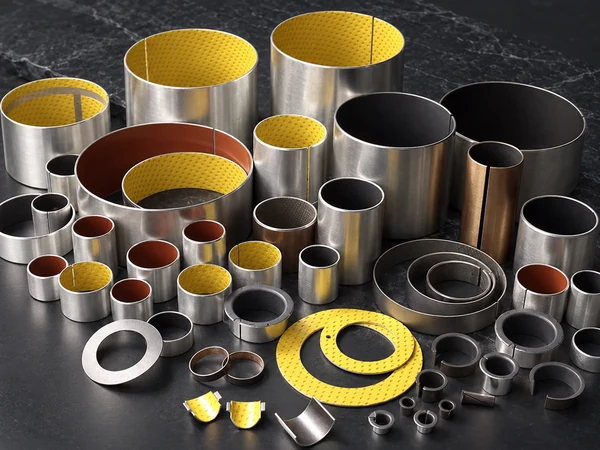
Composite Bushings
Composite Bushings are a practical option where a valve component needs low-friction sliding or rotary support, particularly where lubrication is limited and maintenance at the valve bushing location has to come down.
Typical considerations:
- low friction
- dry or limited lubrication
- sliding or rotary movement
- compact installation
- controlled clearance
Suitable for shaft support, guide support, and other valve component interfaces where the operating conditions match the material grade.
View Composite Bushings →
Solid Lubricated Bearings
Solid Lubricated Bearings suit demanding applications where high loads, repeated movement, or limited access for lubrication make a self-lubricating bearing the practical choice. On valve shaft bushings and other valve components they cover heavy-duty valve shaft support and rotary applications.
Typical considerations:
- high load
- oscillating or rotary movement
- limited lubrication
- demanding operating environment
- maintenance access
Typical valve applications: butterfly valve bushings at the shaft support, heavy-duty rotary valve components, and other high-load support locations.
View Solid Lubricated Bearings →
Bimetal Bearings
Bimetal Bearings combine a steel backing with a sintered bearing layer, which suits a bushing that has to handle higher loads or demanding mechanical conditions.
Typical considerations:
- higher load
- shock loading
- lubricated operation
- high strength backing
- compact bearing design
For valve components, Bimetal Bearings cover support points exposed to higher mechanical loads.
View Bimetal Bearings →
Sintered Bushings
Sintered Bushings use a porous metal structure and retain lubricant inside the bearing material.
Typical considerations:
- lubrication retention
- repeated movement
- limited installation space
- speed
- temperature
- material grade
The actual temperature and load capability depend on the selected material and the operating conditions, so a sintered bushing suits selected valve components where the structure, speed, temperature, and lubrication requirements match.
View Sintered Bushings →
Bronze Wrapped Bushings
Bronze Wrapped Bushings are a traditional option for lubricated sliding support, and they suit an application with a working lubrication system that needs a bronze bearing surface. A grease film is what lets the bronze reduce friction at low sliding speed.
Typical considerations:
- lubricated operation
- lower-speed movement
- sliding or oscillating movement
- shaft and housing dimensions
- maintenance conditions
For valve components, treat them as a lubricated bearing option rather than a maintenance-free solution. Valve bushing material selection decides this, so send the lubrication condition with the drawing.
View Bronze Wrapped Bearings →FAQ
Can I replace a valve bushing with the same material as the original?
Not always. If the original bushing wore out prematurely, that material may not have suited the actual load, movement, temperature, lubrication, or environment.
Review the failure condition before selecting the replacement.
Why did the new bushing wear out faster than the original one?
Check whether the shaft, the housing, the clearance, the alignment, the load, or the lubrication condition changed.
A new bushing also wears quickly when the shaft or the housing is already damaged.
Can I replace only the bushing if the shaft is worn?
Not necessarily. If the shaft surface has excessive wear, scoring, or an incorrect diameter, a new bushing may not reach the required running clearance.
Check the shaft condition before installing the replacement.
How can I identify the correct bushing when the valve drawing does not show the bushing number?
Start from the moving component and its support location.
If the drawing does not identify the bushing clearly, send the valve assembly drawing, the old bushing, or photos showing the installation location.
The shaft and housing dimensions are also useful for identification.
Why does one side of my bushing wear more than the other?
One-sided wear can come from shaft misalignment, housing alignment, excessive side loading, or installation conditions.
Inspect the shaft and the housing before installing another bushing.
Can one valve require different bushing materials at different locations?
Yes. Different support locations see different loads, movements, temperatures, and lubrication conditions, so the material should be selected for the operating condition at each one.
Not Sure Which Valve Bushing You Need?
Send us any of the following:
- valve assembly drawing
- old bushing drawing
- bushing sample
- shaft diameter
- housing bore
- valve model
- operating conditions
We can review the bushing location, the dimensions, the movement, and the working conditions and recommend the right valve shaft bushings for your valve.
Need Self-Lubricating Bearings?
Contact GLARY for bearing solutions and pricing.