
Wind Turbine Bushings for Pitch and Yaw Systems
Wind turbine bushings sit in the hub on the blade pitch system and in the nacelle on the yaw system, carrying the pins and pivots of the pitch mechanism, the yaw brake and the yaw drive. What each position needs depends on its movement and its load.
Where Are Bushings Used in a Wind Turbine?
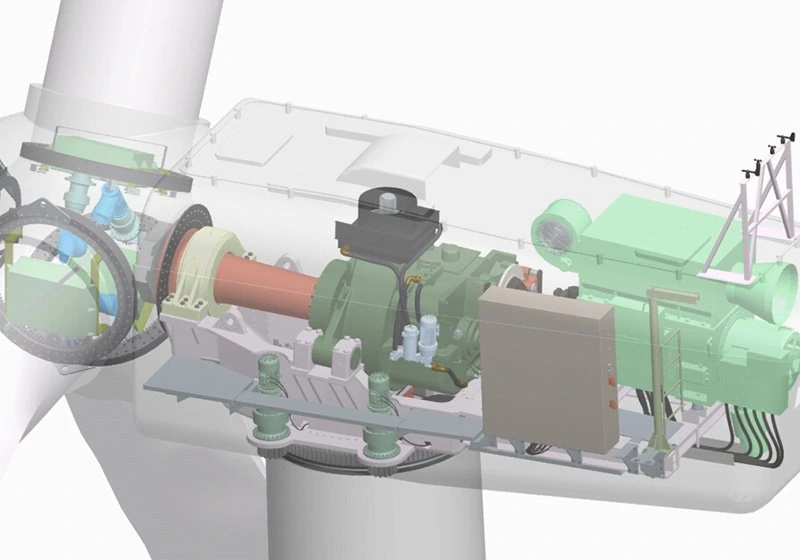
Wind turbine bushings work in several different mechanisms, and each one does a different job. Wind turbine pitch bushings sit in the hub on the blade pitch system; wind turbine yaw bushings sit in the nacelle, on the yaw system and the yaw drive. Each position has its own movement and its own load, and those two decide the material.
| System | Bushing location | Typical movement or working condition |
|---|---|---|
| Pitch system | Hydraulic cylinder or actuator mounting pins | Oscillation during blade pitch adjustment |
| Pitch mechanism | Linkage pins and pivot joints | Repeated angular movement under changing loads |
| Yaw system | Brake guide pins and sliding connections | Short sliding movements during brake operation |
| Yaw drive | Linkage pivots and supporting pins, where fitted | Low-speed movement and intermittent loading |
| Rotor locking mechanism | Lock-pin guide bushings, where fitted | Infrequent movement with potentially high static loads |
Any of these positions can carry a bushing, and the list shifts with the turbine design and with what is fitted in the nacelle. A blade root pitch bearing or the main yaw bearing is a large rolling-element part. Pitch bearing bushings and yaw system bushings are the small pin, guide and linkage parts around those bearings. The two families are not interchangeable.
What Matters When Selecting Pitch and Yaw Bushings?
The same material can behave differently in a pitch linkage and a yaw brake, so wind turbine pitch bushings and wind turbine yaw bushings are worth judging one position at a time. Before choosing a replacement wind turbine bushing, look at how the joint moves and what it has to carry.
Oscillation is different from continuous rotation
In the pitch system, the blade turns as the controller adjusts its angle. A bushing in an actuator mount or a linkage pivot oscillates through a small angle and never completes a rotation.
The oscillation angle, the cycle frequency, the contact pressure and the shaft finish all matter here. Choose a bushing on its maximum load rating alone and it will not deliver the service life that rating suggests.
Load changes with the mechanism
A linkage pin in the pitch mechanism sees radial load that keeps changing. A brake guide or a locking pin sees static load, sliding friction and impact in combinations that shift with every cycle.
The load at the bushing interface matters more than the size of the turbine. Static capacity, dynamic performance and shock loading are three separate questions, and each needs its own figure.
Lubrication access affects maintenance
Some joints can be greased on a scheduled visit. Others are hard to reach, or awkward to get a grease gun to.
A self-lubricating bushing takes the greasing task off the schedule, but it still wears. Load, movement, temperature and what the nacelle environment does to the sliding surface all stay in the calculation.
Which GLARY Bushing Series Should You Consider?
GLARY supplies five bushing series. Between them they cover the wind turbine pitch bushings, the wind turbine yaw bushings and the guide and locking-pin positions beside them, and each series suits a particular mix of movement, load and lubrication.
| GLARY series | Potential wind turbine locations | When to consider it |
|---|---|---|
| PTFE Composite Bushings | Pitch actuator mounting pins, linkage pivots, suitable yaw brake guides | When low friction and reduced reliance on external lubrication are priorities |
| Solid Lubricated Bearings | Suitable heavy-load pivots and rotor lock-pin guide locations | When low-speed movement, high loads or difficult lubrication conditions need to be assessed |
| Bimetal Bearings | Lubricated pitch or yaw linkage pivots and heavier pin supports | When the joint needs a metal sliding layer and can receive suitable lubrication |
| Bronze Wrapped Bushings | Lubricated pivots and pin joints designed for bronze bushings | When a conventional lubricated metal bushing suits the load and movement |
| Sintered Bushings | Selected auxiliary mechanisms with suitable speed and load conditions | When oil-impregnated porous bearings suit the operating environment |
How to narrow the choice
Take a pitch actuator pin that oscillates and cannot be greased. Start with PTFE composite, then check the pressure, the oscillation angle, the shaft finish and the clearance before you commit.
A heavily loaded pivot is a straight contest between solid lubricated bronze and a lubricated bimetal bearing. Load capacity is the headline figure; lubrication access, impact, contact geometry and the service interval decide the rest.
Bronze wrapped and sintered bushings earn their place where the lubrication and the running conditions suit the mechanism. Both rely on oil or grease reaching the sliding surface.
The final choice comes down to the GLARY material data and the operating conditions on your own turbine.
What Should You Check When Replacing an Existing Bushing?
A wind turbine bushing that has worn out is rarely a straight like-for-like swap. The bore and the outside diameter are the easy part; the shaft, the housing and the way the joint moves decide whether the new one lasts.
| Check | Information to confirm |
|---|---|
| Dimensions | Inside diameter, outside diameter, length and any flange dimensions |
| Shaft | Diameter, hardness, surface finish and wear condition |
| Housing | Bore tolerance, housing material and installation method |
| Movement | Oscillation angle, frequency, sliding distance or rotational speed |
| Load | Radial load, static load, impact and operating cycles |
| Lubrication | Dry running, grease lubrication or oil lubrication |
| Environment | Operating temperature, moisture, dust and corrosion exposure |
If the old bushings wore unevenly, look at the pin and the housing before you order. An out-of-round bore, a scored shaft or excessive clearance will shorten the life of the new bushing.
Send the drawing or the measured dimensions and GLARY will check them against the standard range of wind turbine bushings, including wind turbine pitch bushings and wind turbine yaw bushings. If nothing standard fits, the component drawing and whatever operating data you have let us check the material against your application.
What Bushing Wear Can Tell You About the Mechanism
Read the wear pattern before you blame the material. Where the metal has gone tells you whether the problem is the bushing, the shaft or the way the joint moves.
Wear concentrated on one side
That points to uneven loading, a misaligned shaft or a housing bore that is out of line. Check the pin and the mounting before you reach for a harder material.
Excessive clearance or movement at a pivot
Clearance opens up as the sliding surfaces wear. In a pitch linkage the lost movement shows up in the blade angle and puts extra stress on everything connected to it. Measure the clearance against its limit and check the mating pin.
Scoring, surface damage or unusual friction
Look at the shaft finish, at what has got into the joint, at the lubrication and at the running temperature. Changing the material only helps once you know what caused the damage.
Repeated wear despite replacing the bushing
If a second bushing fails the way the first one did, the joint needs looking at as a whole. Load distribution, greasing access, how it was fitted and the state of the shaft all feed into service life.
On a hydraulic actuator connection the pin and the joint have to be judged together, because the load passes through both. Our Hydraulic Systems Bushings page covers that group.
What Information Helps Us Recommend a Suitable Bushing?
You do not need every engineering parameter to start an enquiry about wind turbine bushings. Send what you have and we will tell you what is still missing.
- Application: blade pitch actuator, pitch linkage, yaw brake, yaw drive or another mechanism.
- Dimensions: inside diameter, outside diameter, length and flange details, if applicable.
- Movement: oscillation, reciprocating sliding or continuous rotation.
- Load: known radial load, static load or estimated operating pressure at the bushing interface.
- Lubrication: whether grease or oil is available, and how often the joint can be serviced.
- Environment: operating temperature and exposure to moisture, dust or corrosive conditions.
- Existing part: material designation, part number, sample or engineering drawing.
Missing values are normal. Send the drawing and describe what the joint is doing wrong, whether the enquiry is about pitch bearing bushings, yaw system bushings or a linkage pin. Between them we can narrow the field to one or two series and say which figures we still need.
For other heavy-load pin and pivot work, see Mechanical Joints Bushings.
Frequently Asked Questions
Are wind turbine bushings interchangeable between different turbine models?
Not always. Two bushings with the same nominal size can differ in clearance, sliding material, load limit and lubrication. Check the original drawing, the shaft and housing fit, and the running conditions before you approve a replacement.
Can a worn bushing be replaced without replacing the pin?
Sometimes. If the pin is still inside its diameter, hardness and surface-finish limits, a new bushing on its own can be enough. A pin that is scored, bent or worn past tolerance usually has to be dealt with first.
Does a bushing need to be replaced because it has reached a fixed number of operating hours?
There is no fixed interval that covers every wind turbine bushing. Life depends on the load, the movement, the lubrication, the site conditions and how much clearance the joint will tolerate. Work to the turbine manufacturer's maintenance schedule and measure the part against its limits.
Can one bushing material be used throughout the pitch and yaw systems?
Pick the material one component at a time. A pitch actuator pivot, a yaw brake guide and a lubricated yaw drive linkage see different loads, different movement and different maintenance, and a single grade rarely covers all three.
What if the original bushing material or part number is unknown?
Send the dimensions, a drawing or a sample, and the shaft details, along with a note on how the mechanism runs. A photograph of the worn part shows how it was built, though not the material grade or the load rating.
Send Your Wind Turbine Bushing Requirements
Looking for a replacement or a bushing for a new design? Tell us where the bushing sits, how the joint moves and what dimensions you have. We will come back with the series that fits and the figures we still need. Standard sizes and made-to-drawing options are both available, subject to a specification review.
Need Self-Lubricating Bearings?
Contact GLARY for bearing solutions and pricing.