
Robot Arm Bushings
Bushings for industrial robot joints, pivots and high-cycle motion. GLARY supplies composite, bimetal, solid lubricated and bronze wrapped bushings for robot arm applications where repeated movement, load, clearance and lubrication need to be controlled.
Where Are Bushings Used on a Robot Arm?
Robot arm bushings are not used in every bearing position of an industrial robot. They are typically found where two components move relative to each other around a pin, shaft or pivot.
Common locations include arm linkage pivots, joint pins, wrist mechanisms and gripper linkages.

Arm Linkage Pivot
The connection between two arm sections can see repeated oscillation, radial loads and side loads as the robot changes direction.
Joint / Pivot Pin
A bushing can provide the replaceable wear surface between the pin and the surrounding component.
Wrist / Tool Mechanism
Smaller pivoting mechanisms around the wrist or tool can require compact bushings for repeated movement and frequent start-stop cycles.
Gripper Linkage
Pins and linkages inside a gripper repeatedly open and close. Wear at these points can gradually increase clearance and affect the movement of the tooling.
The exact bushing locations depend on the robot design. The important point is to identify the joints where a pin and bore move against each other.
What Does the Bushing Do at Each Position?
A robot arm bushing does more than reduce friction. It provides a controlled wear surface between the pin and the surrounding component while allowing the joint to move repeatedly.
| Robot position | Main operating conditions | What the bushing helps control |
|---|---|---|
| Arm linkage pivot | Repeated oscillation, radial load and side load | Wear, friction and joint clearance |
| Joint / pivot pin | Repeated movement and load reversal | Pin-to-bore wear and play |
| Wrist / tool mechanism | Frequent movement in a compact mechanism | Friction, noise and premature wear |
| Gripper linkage | High cycle count and repeated opening/closing | Looseness and movement accuracy |
As the bushing wears, clearance between the pin and bore increases. For a robot that repeats the same movement thousands of times, even a small increase in clearance can become an operating problem.
How Do You Know a Robot Arm Bushing Needs Replacing?
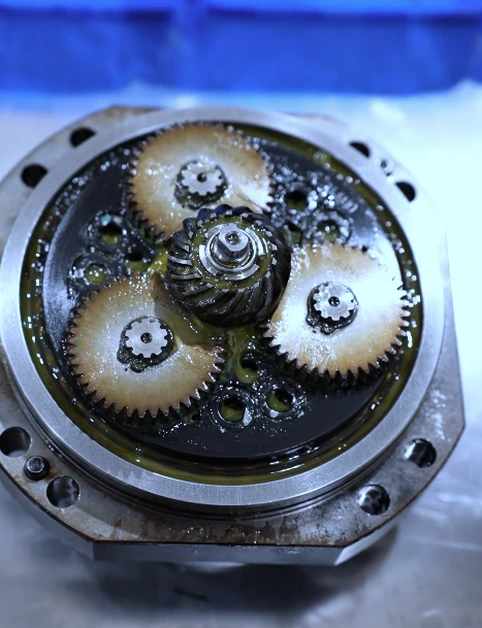
A robot arm bushing usually gives warning before it fails. As the bushing wears, clearance at the joint grows and the arm's movement changes gradually.
On a high-cycle industrial robot, small changes at a pivot become noticeable during repeated movement, especially when the joint accelerates, stops or changes direction.


More Play at the Joint
The joint moves more radially than it did when new. With the robot safely stopped and secured, that movement at a bushing-supported pivot usually means more clearance between the pin and the bushing.
Movement Changes During Direction Reversal
The joint behaves differently when the arm changes direction. A worn bushing lets the pin and bore move more against each other, so the slack is most noticeable on repeated forward and reverse strokes.
Positioning Becomes Less Consistent
The arm no longer reaches the same position as consistently as it did, and it shows up first in work that depends on repeatability: picking, assembly, machine tending or tool handling. A change in positioning does not always come from the bushing, because gearboxes, bearings, encoders, alignment and other mechanical parts also affect where the arm ends up and the precision it holds. Check the whole joint.
Knocking, Clicking or Increased Mechanical Noise
Unusual noise appears when a joint starts, stops or changes direction. A worn joint with excessive clearance lets mating parts move against each other, and the knock is most noticeable in high-cycle operation.
Wear Marks on the Pin or Bushing
During inspection, look for scoring, uneven wear, polishing marks or material transfer on the pin or bushing. If the wear sits on one side, check the housing bore and alignment before fitting a replacement bushing.
More Frequent Maintenance
If one joint keeps needing adjustment, lubrication or inspection, check its bushing and the parts it runs against. A change in maintenance frequency means the joint is no longer working under the conditions it was set up for.
Increased play, unusual noise and changes in movement do not always come from the bushing. Check them alongside the pin, the housing bore, lubrication, alignment and the other joint parts before deciding what to replace.
What Happens If You Keep Running a Worn Bushing?
A small amount of joint clearance does not stop a robot immediately.
The trouble starts when the arm keeps running the same cycle while the clearance grows. Acceleration, deceleration and frequent direction changes make the wear progressively more noticeable.
Joint Clearance Continues to Increase
As the bushing wears, the pin has more room to move inside the joint. Repeated movement opens the clearance further, especially where a joint oscillates often, sees load changes or reverses direction.
More Movement at the Pin
With more clearance, the pin moves inside the bushing before the joint itself moves. The mating surfaces then make more contact and take more impact, so the worn area carries a higher mechanical load.
Pin and Housing Bore May Also Wear
If the worn bushing stays in service, the wear stops being limited to the bushing. The pin tends to pick up scoring or wear unevenly, and repeated movement damages or enlarges the housing bore. Once the pin or the bore is damaged, a new bushing on its own will not always bring the joint back to its original condition.
Movement Becomes Less Consistent
Excessive joint play makes repeated movements less consistent, especially during acceleration, stopping and direction reversal. In assembly, picking, welding, machine tending and material handling, that eventually shows up as variation in the production process.
Maintenance Becomes More Extensive
A bushing is normally a replaceable wear component. Leave significant wear alone and the repair grows from a bushing replacement into inspection or replacement of the pin, the housing or other joint components.
Unplanned Downtime Becomes a Bigger Risk
A worn bushing keeps working for a while before the joint becomes unusable. On a production robot, an unexpected joint problem stops the cycle and needs extra inspection before the machine goes back into service, so the condition is worth acting on well before that point.
The earlier you spot the wear, the easier it is to tell whether the bushing, the pin, the housing or another joint component needs attention.
Which Bushing Fits a Robot Arm Application?
There is no single bushing construction for industrial robot bushings.
The right choice depends on the movement, load, lubrication and service conditions at the specific position.
| GLARY product family | Suitable conditions to consider | Typical robot arm positions |
|---|---|---|
| Composite Bushings | Dry running, repeated oscillation and low-maintenance operation | Arm pivots, linkage joints, wrist mechanisms and gripper linkages |
| Bimetal Bearings | Higher loads where oil or grease lubrication is available | Loaded arm pivots and joint mechanisms |
| Solid Lubricated Bearings | High load, low speed, intermittent movement or locations where external lubrication is difficult | Heavy-duty pivots and loaded linkage points |
| Bronze Wrapped Bushings | Low-speed movement with grease lubrication and good load capacity | Pivot pins, linkages and other lubricated joints |
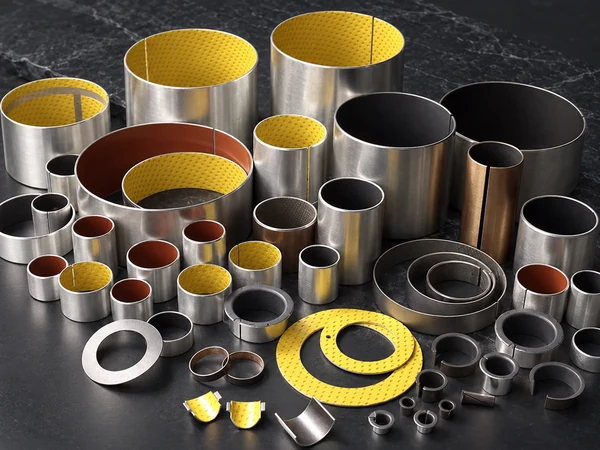
Composite Bushings
Composite bushings, just like our PTFE composite and POM composite bushings, suit a joint that has to run with little or no external lubrication.
They handle repeated oscillation and high-cycle movement, where low friction and controlled wear matter.
Typical positions are arm linkages, pivot joints and gripper mechanisms.
View Composite Bushings →
Bimetal Bearings
Bimetal bearings fit loaded robot arm positions where lubrication is available.
The steel backing carries the structural load, and the bearing layer is matched to the load and lubrication at the joint.
They make sense where a joint carries substantial radial load and lubrication is already part of the maintenance routine.
View Bimetal Bearings →
Solid Lubricated Bearings
Solid lubricated bearings fit positions where the load is high and lubrication is limited.
They work in low-speed and intermittent movement where external lubrication is difficult or unwanted.
Check the load, movement and clearance at the joint before you choose this construction.
View Solid Lubricated Bearings →
Bronze Wrapped Bushings
Bronze wrapped bushings fit loaded pivot points where grease lubrication is available.
They suit oscillating or intermittent movement, depending on the load, speed and lubrication at the joint.
They are a common choice for pin-and-bore joints that need a durable bushing which can be serviced.
View Bronze Wrapped Bushings →Pick the product family from the conditions at the joint. The robot type on its own does not decide it.
How to Choose Between Them
Once you know the operating conditions, match the bushing construction to what the joint needs.
Start With the Movement
For an oscillating robot joint, look at:
- Movement angle
- Frequency of movement
- Direction changes
- Cycle rate
A joint that moves through a small angle thousands of times asks something different of a bushing than a shaft that turns continuously. Most robot joints oscillate below 0.5 m/s at the bore. Above about 2.0 to 2.5 m/s, composite materials are outside their range.
Then Check the Load
Look at both the normal operating load and the peak load. On a heavily loaded pivot, the bushing needs enough load capacity for the real contact conditions.
Check shock and side loads too, even when the average load looks acceptable.
As a reference, PTFE and POM composite bushings are rated to about 100 to 140 N/mm² dynamic, and bimetal to about 250 N/mm².
Match the Lubrication Method
If lubricating the joint in service is difficult, a dry-running or self-lubricating construction fits better.
If grease or oil is already part of the maintenance routine, a lubricated construction suits that joint too.
Consider the Cycle Life
A robot running continuously in production builds up a very high number of joint movements. On a high-cycle joint, compare the expected conditions with the bushing's allowable load, speed, PV value and wear characteristics.
The static load alone does not decide the bushing.
Temperature counts as well: PTFE composite runs to about +250 °C and POM composite to about +130 °C.
Check the Mating Components
Choose the bushing together with the pin and the housing. A good bushing on a worn pin or a damaged bore can still end up with excessive clearance.
If the joint has already been in service, inspect the mating components before you order the replacement.
The pivot pin should be harder than the liner and smooth enough not to tear it, typically 45 HRC or above and around 0.4 µm Ra.
Confirm the Dimensions
At minimum, confirm:
Inside Diameter × Outside Diameter × Length
Also check:
- Press fit or installation method
- Flange dimensions if applicable
- Housing dimensions
- Pin dimensions
- Required running clearance
If you have the original drawing, start there.
Send the Actual Application Conditions
When the material or construction is uncertain, send the application information. A size on its own does not narrow the choice enough.
Useful information includes:
- Bushing dimensions
- Load
- Movement type and angle
- Cycle rate
- Lubrication
- Pin condition
- Housing condition
- Temperature
- Working environment
That gives us a much better basis for the recommendation.
Robot Arm Bushing FAQ
Can I replace existing robotic arm bushings with the same dimensions?
Not necessarily. Correct dimensions do not mean the material and construction match the operating conditions at the joint. If the original bushing failed earlier than expected, check the load, the movement, the lubrication and the condition of the pin and housing before you choose the replacement.
Should the pin be replaced when installing a new bushing?
Not automatically. You can reuse a pin that still meets the dimensional and surface limits. A scored, unevenly worn or undersized pin may leave the joint without the running clearance it needs, even with a new bushing.
Can you make a flanged bushing for a robot mechanism?
Yes, depending on the design. We can add a flange where the mechanism needs axial positioning or extra support. Confirm the flange dimensions, the installation method and the available space from the drawing.
Can you supply replacement bushings for an existing industrial robot?
Yes. We can review existing robot bushings from a drawing, dimensions, material construction or the application conditions. If the original specification is unavailable, photos, a sample and information about the robot joint also help.
What if I do not know the original bushing material?
That is not necessarily a problem. We can match a replacement from the bushing dimensions, the application, the movement, the load, the lubrication and the operating environment. A drawing or a sample helps when the original material specification is missing.
Can the same bushing be used in different robot joints?
Different joints carry different loads, move differently, run at different cycle rates and see different lubrication. The same robot can therefore need different bushing constructions or dimensions at different positions.
What information do you need for a quotation?
The basic dimensions are ID × OD × Length. For material selection, also send the load, the movement, the cycle rate, the lubrication condition, the pin information and the operating environment. If you have it, send the drawing or the existing bushing specification with your inquiry.
Need a Bushing for a Robot Arm Joint?
Send us your drawing or existing bushing dimensions.
We can review the joint's load, movement, cycle rate and lubrication conditions and help identify a suitable bushing construction.
Need Self-Lubricating Bearings?
Contact GLARY for bearing solutions and pricing.