
Crane Bushings & Crane Boom Bushings
Crane bushings for boom pivots, boom pins and hydraulic cylinder mounts under heavy load and slow oscillation. GLARY supplies composite, bimetal, sintered, solid lubricated and bronze wrapped grades; load, movement and lubrication decide which fits.
Where Crane Bushings Sit on a Crane

Crane bushings work at pin joints, where the parts move through a limited angle under load. The usual positions are the boom pivot, the boom linkage and the hydraulic cylinder mounts.
Boom pivot and boom pin
The boom pivot carries the boom through every lift and every lowering. The bushing supports the boom pin and gives the joint a replaceable wear surface between the pin and the structure around it.
Boom linkage
Linkage points connect the boom, the hydraulic cylinders and the other moving parts. These joints work through limited-angle oscillation rather than continuous rotation.
Hydraulic cylinder mounting points
Bushings sit at the cylinder base and at the rod end. Both carry the force the cylinder produces while letting it swing through its working angle.
Other pin joints
Depending on the crane, more bushings go into articulated links and other pivot points, including the slew and outrigger joints on machines that have them.
What Makes a Crane Pin Joint Demanding
Crane boom bushings do not turn continuously the way a high-speed bearing does. They carry a heavy load while moving back and forth through a small angle.
Heavy load
The boom, the lifted load and the connected parts put high radial force on the pin and on the bushing.
Oscillating movement
Movement back and forth through a limited angle concentrates wear on one part of the bore instead of spreading it around.
Changing load and shock
The load changes as the boom lifts, moves and positions. Some joints also take impact or uneven loading.
Outdoor conditions
Mobile and construction cranes work in dust, mud and rain.
Lubrication
Some joints are greased on schedule. Others are hard to reach, and those do better with a bushing that needs little or no external lubrication.
Choose the bushing for the conditions at that joint, not for the dimensions alone.
What a Worn Crane Bushing Causes

A crane boom bushing is the replaceable wear part between the pin and the structure around it. As it wears, clearance at the joint opens up.
- More movement between the pin and the bushing
- Uneven load distribution
- More impact at the joint
- Faster pin wear
- Damage to the housing bore
- More play in the boom or the linkage
At a hydraulic cylinder mount, the extra clearance also changes how the pin and the cylinder sit against the mounting structure. A new bushing restores the sliding surface, and it keeps clearance from opening up between the mating parts.
When a Crane Bushing Should Be Replaced
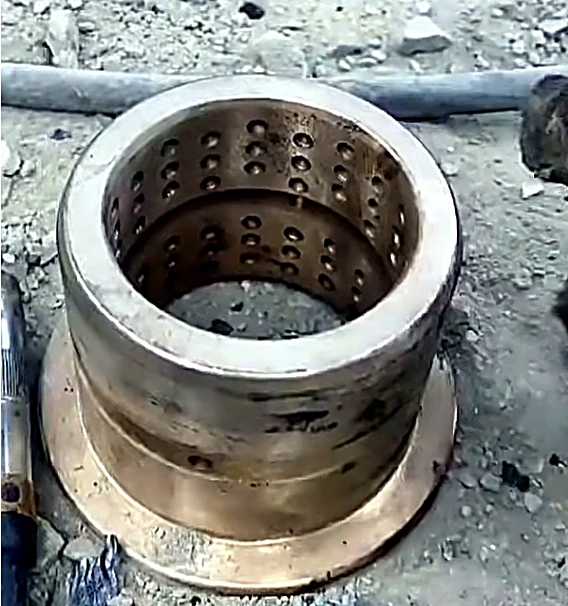

The first sign is usually extra clearance rather than a bushing that has failed outright. Check for:
When a bushing is worn, check the pin and the housing bore at the same time. A new bushing fitted against a worn pin or a damaged bore may not restore the joint.
Why Replace a Worn Bushing Before the Joint Gets Worse
Bushing wear can grow into a much larger repair.
Bushing wear
Increased clearance
More pin movement
Uneven loading and impact
Pin or housing wear
At the early stage a new bushing is usually enough. Once the pin or the housing bore is damaged, the job may need machining, repair or replacement of the component itself.
Check the bushing, the pin and the housing together at every service.

Which GLARY Bushings Fit Crane Applications
Not every joint on a crane needs the same material. Around the boom and the hydraulic cylinder mounts, where the load is heavy, the movement slow and the motion oscillating, three GLARY product groups are the ones to look at.

Bimetal Bearings
For high-load, low-speed oscillating joints: boom pivots, boom pins, heavy-duty linkage points and hydraulic cylinder mounts. Where the joint can be greased, bimetal is the practical choice for a heavily loaded pin.
View Bimetal Bearings →
Solid Lubricated Bearings
For high load and slow movement where lubrication is limited or difficult: heavy-duty boom pivots, articulated joints, linkage pins and other pivot points that are awkward to grease.
View Solid Lubricated Bearings →
Bronze Wrapped Bearings
For crane pin joints that can be lubricated: pivot joints, boom linkage points, hydraulic cylinder mounts and other serviceable pins. The choice between the three depends on load, movement, lubrication and the service life you need.
View Bronze Wrapped Bearings →Composite and sintered bushings
Composite bushings fit selected crane joints where friction and maintenance both have to stay low, as long as the load stays inside the material's limits. Sintered bushings are more application-specific, and they are not the first product to consider for a heavily loaded, slow oscillating boom pivot. Check the load, the movement and the conditions before selecting either.
How to Choose the Right Crane Bushing
For a replacement, the size is only the start. Six things decide the material.
Load
How much radial load does the joint carry? A heavily loaded boom pivot needs a different solution from a small linkage joint.
Movement
Does the joint rotate continuously, or oscillate through a limited angle? Boom pins and hydraulic cylinder mounts usually oscillate slowly.
Lubrication
Can the joint be greased on schedule? If it can, a lubricated bimetal or bronze bushing is on the table. If it cannot, a solid lubricated bushing may suit the position better.
Shock and load changes
Does the joint take impact or a changing load as the boom moves and lifts? This matters most at boom pivots and heavily loaded linkage points.
Environment
Check what the joint is exposed to: dust, mud, water, salt spray and outdoor temperature changes.
Existing pin and housing
For a replacement, measure the pin diameter, the bushing ID, OD and length and the housing bore, and look at the pin surface and the lubrication method.
A drawing, a sample or the worn bushing makes replacement identification much easier.
Crane Bushing Selection Guide
These are the options to consider position by position.
| Crane Position | Typical Condition | GLARY Product Options to Consider |
|---|---|---|
| Boom pivot / boom pin | Heavy load, slow oscillation | Bimetal / Solid Lubricated / Bronze Wrapped |
| Boom linkage | Oscillation, changing load | Bimetal / Solid Lubricated / Bronze Wrapped |
| Hydraulic cylinder rod-end | High load, limited-angle movement | Bimetal / Solid Lubricated / Bronze Wrapped |
| Hydraulic cylinder base mount | High load, oscillation | Bimetal / Solid Lubricated / Bronze Wrapped |
| Other pin joints | Depends on load and lubrication | Composite / Bimetal / Solid Lubricated / Bronze Wrapped |
These are typical options, not fixed recommendations. Final material selection depends on the conditions at the joint and on the mating parts.
FAQ
Can you supply crane bushings to our existing dimensions?
Yes. We can supply bushings according to your existing dimensions or drawing. Please provide the bushing ID, OD, length and any available tolerance requirements.
If you do not have a drawing, an existing bushing or sample can also be used as a reference.
Can you make a replacement bushing from a worn sample?
Yes. A worn bushing can be used as a reference for a replacement, but the worn dimensions may no longer represent the original design.
Where possible, we recommend also providing the mating pin diameter and housing bore so that the required fit can be checked.
Do you supply flanged crane bushings?
Yes, flanged bushings can be manufactured when the crane joint requires axial positioning or additional support.
Please provide the flange diameter, flange thickness and the available installation dimensions along with the basic bushing dimensions.
Can the bushing ID and OD be finished after installation?
For some crane applications, the final bore may need to be matched to the pin and housing conditions.
If machining or finishing after installation is required, please include this requirement when requesting a quotation so that the bushing construction and machining allowance can be considered.
Can you supply the same bushing in different materials?
In many cases, the same basic bushing dimensions can be produced in different material constructions.
However, the material should not be selected only by dimensional compatibility. Changing from one material to another may affect lubrication requirements, clearance, wear performance and service life.
Can you make crane bushings based on an OEM or competitor part number?
We can review an existing part number as a reference, but the part number alone may not provide enough information to confirm a replacement.
Dimensions, material, operating conditions and the mating pin/housing are useful for confirming the correct replacement.
What is the best way to request a crane bushing quotation?
The quickest way is to send us one of the following:
- Bushing drawing
- Existing bushing dimensions
- Part number
- Sample
- Photo with dimensions
- Pin and housing dimensions
If available, also include the approximate load, movement, lubrication method and crane application. This allows us to check both the bushing design and material selection rather than quoting only from dimensions.
Need Crane Bushings or Boom Bushings?
Send us your bushing dimensions, drawing or application details. GLARY can help you select a bushing for crane boom pivots, boom pins, linkage joints and hydraulic cylinder mounting points.
Need Self-Lubricating Bearings?
Contact GLARY for bearing solutions and pricing.