
Tractor Bushings for Linkage, Steering & Pivot Applications
Tractor bushings handle load, oscillation, vibration and dirt in the linkage, steering, front axle, king pin and hydraulic pivot positions. GLARY makes tractor linkage bushings and tractor steering bushings in all five bushing families.
Where Are Bushings Used on a Tractor?
On a tractor, bushings turn up wherever a pin, shaft or joint has to move in a controlled way under load. The three-point hitch, the front axle, the steering and the hydraulic cylinders cover most of them, and the tractor bushings on one machine are usually greased on the same service round.


Steering and front axle
Steering linkage, king pins, the axle ends and the front axle pivot points need bushings that carry repeated movement and load while holding the clearance between the pin and the housing. These are the tractor steering bushings a driver notices first.
Three-point hitch and linkage
Bushings sit around the lift arms, the top links, the linkage pins and the other three-point hitch pivot points. These are the three-point hitch bushings and the tractor linkage bushings that take repeated oscillation, shock loads and dirt from field operation.
Hydraulic cylinder mounts
Hydraulic cylinders create pivoting movement at their mounting points. The bushing there has to take oscillation and load without letting excessive clearance develop.
Rockshaft and control linkage
The rockshaft, the control levers and the other linkage points move repeatedly during operation. Depending on the load and the lubrication conditions, different bushing materials may be considered.
Tractor steering, front axle trunnions and king pins, rockshafts, control pivots and steering cylinders are all plain-bearing positions on the machine.
What Does a Tractor Bushing Need to Handle?
A tractor bushing works in a much harder environment than a shaft turning in a clean housing. Load, oscillation, dirt and vibration all reach the joint, and the service schedule decides how much grease arrives with them.

- Heavy and shock loads. Three-point hitch and linkage joints take high loads when an implement is lifted, lowered or moves over uneven ground. The bushing has to support that load without wearing out of shape.
- Oscillating movement. Many tractor joints never rotate continuously. They move through a limited angle again and again, which is demanding for the bushing and the mating pin.
- Dirt and moisture. Linkage and steering points sit in mud, dust, water and other field debris. Contamination speeds up wear where the bushing and the lubrication do not suit the position.
- Vibration. Steering, axle and linkage components take vibration and repeated impact during field work. Once clearance opens, the movement becomes more noticeable and the joint wears faster.
- Lubrication. Some tractor bushings, at the hitch and the linkage, are regularly greased. Other positions are difficult to reach or suit a self-lubricating bushing better, so the lubrication method belongs in the selection.
What Problems Can a Worn Tractor Bushing Cause?
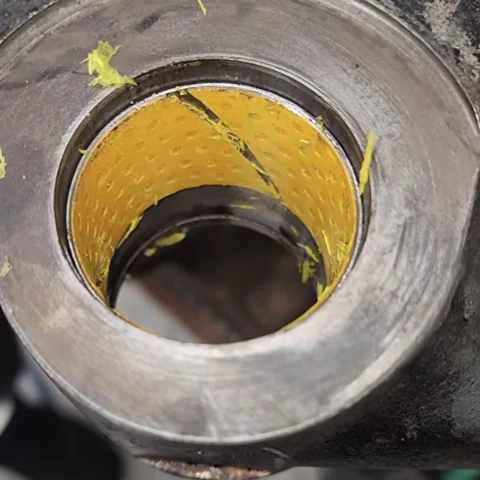
A worn bushing does not always fail suddenly. The first signs are usually more clearance, noise or unwanted movement in the joint, and the tractor steering bushings and the hitch pins can be checked in the same pass, with the front wheels turned and the implement raised.
When a bushing is worn, check the pin and the housing bore at the same time, at the hitch and the axle as much as at the steering. A new bushing fitted against a worn pin or a damaged bore may not restore the joint.
What Happens If You Keep Using a Worn Bushing?
Bushing wear can grow into a joint problem, and the joint is the expensive part to repair.

Worn bushing
The bore loses material on the loaded side.
Increased clearance
The pin no longer sits on full contact.
More pin movement
The pin crosses the gap on each reversal.
Pin and housing wear
The bore goes oval and the pin scores.
Loose linkage or pivot
The joint knocks and the alignment drifts.
More extensive repair
The fix moves from a service part to machining.
When clearance becomes excessive, the mating pin and housing start to wear as well. Replacing only the bushing may then no longer be enough.
For the steering, the front axle and the hitch linkage that also changes the way the connected components move, and it adds to the maintenance the machine needs. Worn tractor steering bushings are usually where that chain starts.
Which GLARY Bushings Can Be Used for Tractors?
Different tractor positions need different combinations of load capacity, movement, lubrication and wear resistance. GLARY offers five bushing series, and the tractor linkage bushings, the three-point hitch bushings and the tractor steering bushings on one machine do not all come from the same one.

Composite Bushings
Considered where low friction and reduced lubrication are needed, and where the load, speed and temperature stay inside the material limits. Typical applications: steering linkage, control linkage, pivot points, hydraulic mounting points.
View Composite Bushings →
Bimetal Bearings
Considered where higher load capacity, good fatigue strength and a rigid steel backing are needed. Typical applications: heavy linkage points, front axle pivots, steering joints, hydraulic pivots.
View Bimetal Bearings →
Solid Lubricated Bearings
Built for high load capacity and low-speed oscillating movement, especially where regular lubrication is difficult. Typical applications: heavy-duty linkage, pivot joints, axle-related positions, other slow-moving high-load points.
View Solid Lubricated Bearings →
Sintered Bushings
Considered where an oil-impregnated bearing material suits the position and continuous or intermittent rotation is required. Suitability depends on the load, speed, temperature and lubrication conditions.
View Sintered Bushings →
Bronze Wrapped Bushings
Considered where a bronze bearing structure and external lubrication are part of the design. Typical applications: linkage pivots, hitch joints, pivot points, high-load low-speed positions.
View Bronze Wrapped Bushings →These are positions to evaluate against the actual working conditions at the joint.
How to Choose the Right Tractor Bushing?
The right tractor bushing depends on the actual working conditions, and the tractor model or the bushing size on its own will not settle it. Check these points before choosing the material and the construction.
Load
Check the normal load and the peak load on the bushing. Three-point hitch bushings, front axle pivots and heavy linkage points may need a higher-load bushing than control or pedal pivots.
Movement
Identify how the joint moves. Tractor hitch, linkage, axle and steering joints often work with slow, repeated oscillation, and the movement angle and frequency both count.
Lubrication
Check whether the bushing can be greased regularly. Where lubrication is difficult or has to be reduced, a self-lubricating bushing may be the better option. Where grease is available, a lubricated bimetal or bronze wrapped bushing can also be considered.
Dirt and moisture
Consider whether the joint is exposed to mud, dust, water or other contamination. Linkage and steering positions working outdoors may need a material that keeps its performance in those conditions.
Pin and housing
The bushing works together with the mating pin and housing. Check the pin diameter, the housing bore, the pin condition, the hardness and the wear already there. A worn pin or housing affects the performance and service life of a new bushing.
Temperature
Check the actual operating temperature, especially for bushings near the engine, the transmission or the hydraulic system, and keep it inside the working limits of the selected material.
Choosing the GLARY bushing
Once these conditions are known, we can help evaluate the suitable series:
- Composite Bushings for selected low-friction, self-lubricating positions.
- Bimetal Bearings for positions requiring higher load capacity and a rigid steel backing.
- Solid Lubricated Bearings for high-load, slow-moving or oscillating positions where regular lubrication is difficult.
- Sintered Bushings for suitable rotating positions where an oil-impregnated bearing material is appropriate.
- Bronze Wrapped Bushings for high-load, low-speed positions where external lubrication is available, such as hitch joints and linkage pivots.
The final selection rests on the complete set of operating conditions at the joint.
Not Sure What Tractor Bushing You Need?
Replacing a worn tractor bushing is not always as simple as matching the old dimensions. The original bushing may already be worn, and the mating pin or housing may also have changed.
You can send us what you have:
If the original bushing is already worn, the pin and housing dimensions are useful as well. They show whether the replacement should follow the original size or whether the joint needs additional inspection first. That applies at the hitch, the axle and the steering alike. We can review the available information and help determine the required bushing dimensions, material and construction for the application.
Have an old bushing but no drawing? Send us the sample or dimensions.
FAQ
Can you manufacture tractor bushings from an existing sample?
Yes. An existing bushing can be used as a reference for the dimensions, the construction and the material evaluation. If you can also send the mating pin or more application information, that helps us check the material at the same time.
Can you supply custom-size tractor bushings?
Yes. Non-standard dimensions, wall thicknesses, lengths, flanges and other configurations can be discussed against the application and the production requirements.
Can you make tractor bushings according to an OEM part number?
If you provide the OEM part number together with a drawing, a sample or the dimensional information, we can review the required specification and discuss a replacement solution.
Do you supply flanged tractor bushings?
Yes. Flanged bushings can be considered where axial positioning or an additional bearing surface is required. The flange dimensions follow the joint design.
Can one bushing design be used on different tractor models?
It can be possible where the application dimensions and the operating conditions are the same, but the tractor model alone does not determine bushing compatibility. The pin, the housing, the load, the movement and the clearance all have to be checked.
What if I only know the tractor model and part number?
Send us the information you have. A tractor model, an OEM part number, the old bushing or a photo helps us understand the application. Dimensional information is still preferred for confirming the replacement specification.
Can you supply small quantities for replacement or testing?
Discuss the quantity you need with us. Sampling and production requirements are evaluated against the bushing design and the material.
Need Tractor Bushings?
Send us your drawing, the bushing dimensions or the application details. We can help you evaluate the right bushing material and construction for your tractor hitch, linkage, axle, steering or pivot application.
Need Self-Lubricating Bearings?
Contact GLARY for bearing solutions and pricing.