
Excavator Bushings for Boom, Arm, Bucket and Linkage Pivots
Excavator Bushings sit at every joint that takes the digging force, from the boom and arm pivots to the bucket and linkage pins. We make excavator boom bushings in bimetal, bronze wrapped and solid lubricated bronze, in standard metric and inch series or to your drawing.
Where the Excavator Bushing Sits
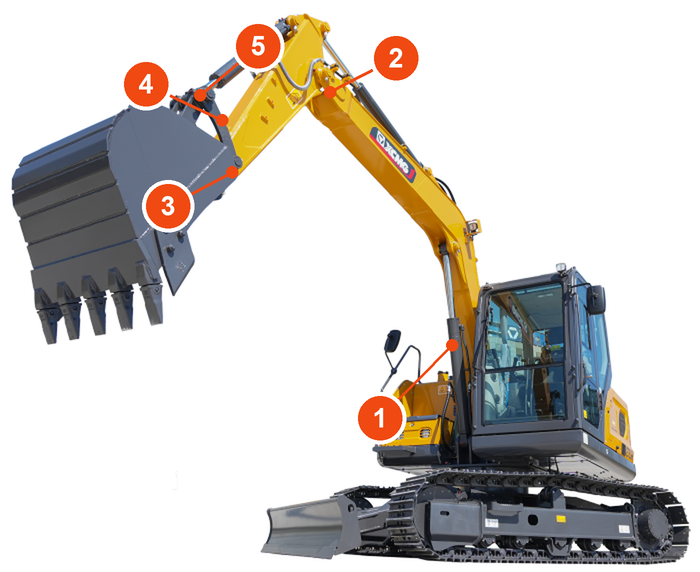
Excavator bushings are used at the main pivot points where pins connect the boom, arm, bucket and linkage components. Depending on the machine design, bushings can also be found at hydraulic cylinder eyes, quick-coupler connections and other articulated joints.
These positions do not all work under the same conditions. Load, movement, lubrication and contamination can vary from one joint to another.
Boom foot pivot
Where the boom attaches to the upper structure. Two pins, one each side of the boom foot, carry the weight of the whole front end and the digging reaction behind it. At the boom pivot the load reverses on every bucket stroke.
Boom-to-arm pivot
The knuckle between boom and arm. This is the heaviest load path on the machine, and it travels through its full arc on every cycle.
Arm-to-bucket pivot
The joint between arm and bucket, the last link before the cutting edge. The arm pivot here is short and stiff, so a little bore wear shows up quickly as bucket rattle.
Bucket linkage and idler
The link bars, the idler and their pins. The excavator bucket bushings at this joint run in the link bars and the idler. The excavator linkage bushings beside them share the load coming back from the bucket cylinder through a linkage pin.
Cylinder rod-end eyes
Where the boom, arm and bucket hydraulic cylinder rods pin to the structure. Each rod end carries one or two bushings, and the boom lift cylinder eye also resists side load.
Offset-boom and quick-coupler pivots
Offset machines add a joint between the boom foot and the main boom, and a quick-coupler bracket adds one more pin at the bucket. Both are small joints, and they are usually the last ones greased.
Not marked on the photo: this machine has a one-piece boom and a pin-mounted bucket, so there is no offset-boom pivot and no quick coupler to point at. The positions above are where those parts sit when they are fitted.
What the Bushing Does at This Position
The bushing sits between the pin and the housing or boss. Its job is to provide a controlled bearing surface while the joint moves under load.
At an excavator pivot, the bushing needs to:
- support the pin under heavy load
- accommodate slow oscillating movement
- reduce direct wear between the pin and housing
- work with the joint's lubrication system
- act as a replaceable wear component
When the bushing wears, the problem can extend beyond the bushing itself. Continued movement can damage the pin or enlarge the housing bore.
What Matters When Choosing an Excavator Bushing
Excavator joints do not all work under the same conditions. A boom pivot, bucket linkage and hydraulic cylinder eye can see different combinations of load, oscillating motion, shock, lubrication and contamination.
The right bushing depends on these working conditions — not simply on the size of the pin or the machine model.
Load & Shock
Excavator pivots can see high static loads, alternating loads and impact during digging, lifting and loading. The bushing material needs enough load capacity for the actual joint.
Oscillating Motion
Most excavator joints do not rotate continuously. They move back and forth through a limited angle, often under high load and low speed.
Lubrication
Some joints are regularly greased, while others may require a lower-maintenance bearing solution. The lubrication method should match the bushing material and joint design.
Dirt & Contamination
Mud, dust, water and abrasive particles can enter excavator joints. The bushing and lubrication arrangement need to suit the actual working environment.
Pin, Bore & Installation Space
The condition of the pin and housing bore matters as much as the bushing itself. Worn pins, oversized bores, limited wall thickness or restricted installation space can affect the bushing design.
Signs the Bushing Needs Replacing
Excavator bushings usually show warning signs before the joint develops serious damage. Common signs include:
- Excessive movement or play at the joint
- Knocking or rattling during machine operation
- Uneven, tapered or enlarged bushing bore
- Scoring, pick-up or smeared material on the bearing surface
- Grease leaking or failing to reach the running surface
- Visible wear on the pin
- Fretting, corrosion or cracking around the joint
If a worn bushing is replaced early, the pin and housing are more likely to remain within a condition suitable for normal repair.


What It Costs If You Leave It
A worn excavator bushing does not always remain a bushing problem.
Continued movement can increase clearance between the pin and housing, accelerating wear on both components. If the housing bore becomes oversized or the pin is badly worn, repair may require line boring, welding, machining or pin replacement.
That can turn a relatively simple bushing replacement into a larger repair job and increase machine downtime.


GLARY Bushing Options for Excavator Applications

Bimetal Bearings
A practical option for heavily loaded excavator pivots where the joint is regularly lubricated. The steel backing provides structural support, while the sintered bronze layer forms the running surface.
View Bimetal Bearings →
Bronze Wrapped Bearings
Suitable for applications requiring a thin-wall bronze bushing with lubrication pockets. They can be considered for joints where regular external lubrication is part of the maintenance system.
View Bronze Wrapped Bearings →
Solid Lubricated Bearings
Designed for applications where regular greasing is difficult or a lower-maintenance solution is required. Suitability depends on the actual load, movement and environmental conditions.
View Solid Lubricated Bearings →The suitable bushing type depends on the joint conditions and the design of the pin and housing.
Match the Bushing to the Joint
| Joint condition | What to consider | Possible GLARY solution |
|---|---|---|
| High load + regular grease | Load capacity, wall thickness, pin condition | Bimetal |
| Thin-wall requirement + grease | Available installation space, lubrication | Bronze Wrapped |
| Difficult to grease | Maintenance interval, load and movement | Solid Lubricated |
| Heavy contamination | Sealing, grease arrangement, surface condition | Depends on joint design |
| Worn pin or housing | Pin diameter, bore size, repair condition | Custom sizing / engineering review |
For an exact recommendation, GLARY can review the pin diameter, housing bore, bushing dimensions, load, movement, lubrication method and operating conditions.
FAQ
Can you make excavator bushings to OEM dimensions?
Yes. GLARY can supply bushings according to customer drawings, existing bushing dimensions or specified pin and housing dimensions.
How do I identify the correct excavator bushing?
The most useful information includes the bushing ID, OD, length, pin diameter, housing bore, lubrication method and working conditions.
Do you supply boom, arm and bucket bushings?
Yes. GLARY can supply bushing solutions for boom pivots, arm pivots, bucket linkages and other articulated joints.
Can you supply bushings for a worn pin or housing bore?
Yes. If the original dimensions have changed because of wear, provide the current pin and bore measurements. This helps determine the appropriate replacement dimensions.
Are excavator bushings always made from bimetal?
No. Bushing material depends on the joint's load, movement, lubrication, contamination and installation conditions. Bimetal, bronze wrapped and solid lubricated bushings can each be suitable for different applications.
Can you supply non-standard excavator bushings?
Yes. Custom dimensions can be produced based on drawings, samples or specified dimensions and operating conditions.
Send the pin and bore dimensions
Inside diameter, outside diameter, length, the load and the movement. We come back with a material and a bore tolerance.
Need Self-Lubricating Bearings?
Contact GLARY for bearing solutions and pricing.